Showing posts with label asynchronous development. Show all posts

Wednesday, October 18, 2017

Preparing for Parent-Teacher Conferences: Part 1 of a 4 part series

Understanding the Asynchronous Development of the Gifted Child

By Stephanie Newitt

Parent-Teacher Conferences are one week away in Gilbert Public Schools.  These experiences are designed to be focused on discussing both the strengths and challenges of the child as well as goals to promote the child's growth and development.  How can a parent of a gifted child prepare for these conferences with giftedness in mind?

One of the key points to understand in the growth and development of a gifted child is asynchrony.  The National Association for Gifted Children (NAGC) describes asynchronous development as follows:

Asynchrony is the term used to describe the mismatch between cognitive, emotional, and physical development of gifted individuals. Gifted children often have significant variations within themselves and develop unevenly across skill levels. For example, a gifted child may be excellent in math, but poor in reading--or vice versa. Often, intellectual skills are quite advanced, but fine motor or social skills are lagging. Experts do not completely agree, but because asynchrony is so prominent in gifted children, some professionals believe asynchronous development rather than potential or ability, is the defining characteristic of giftedness.

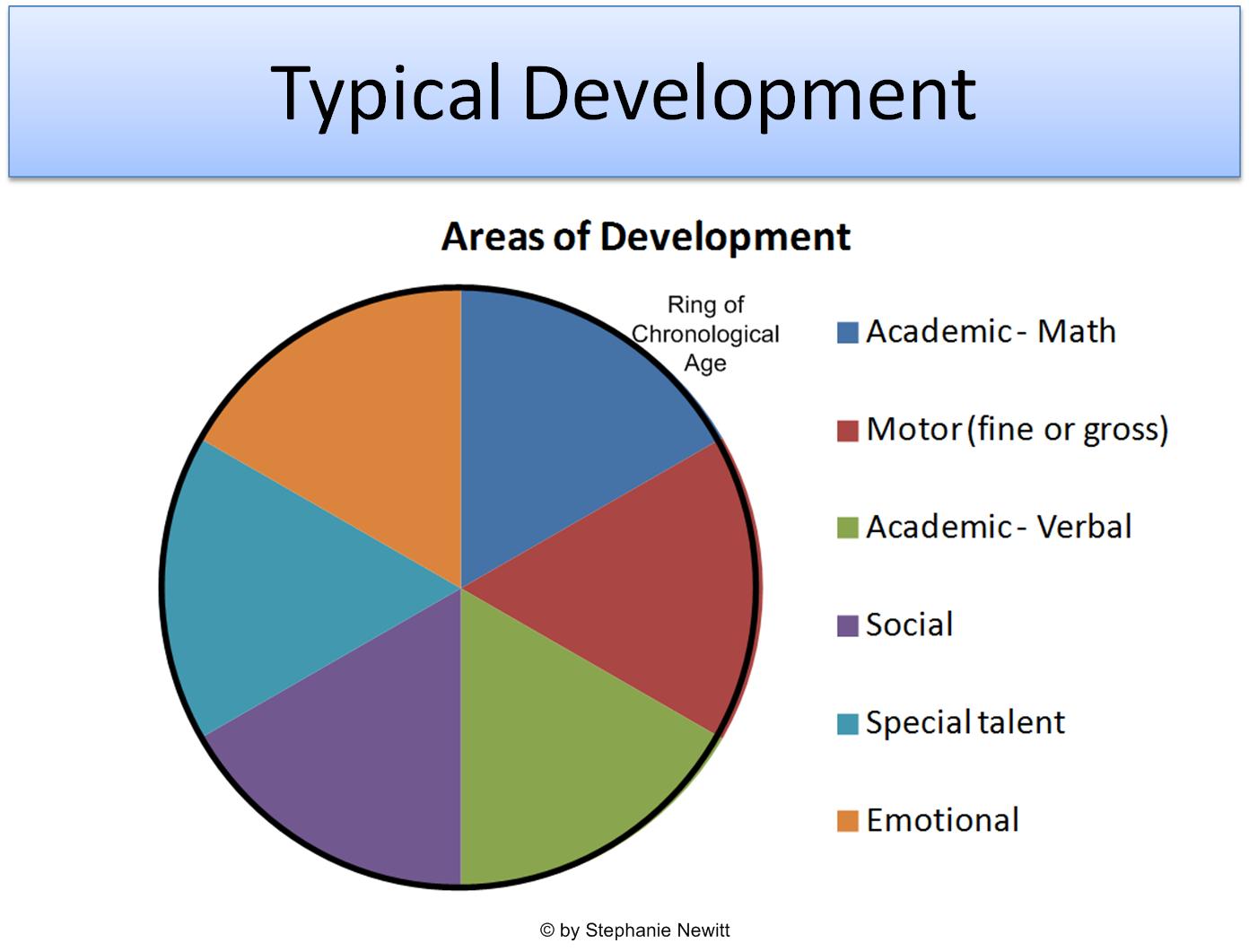
Below are graphics that depict the contrast between typical and asynchronous development.


If you have ever looked at your intelligent child and wondered, exasperated, "What were you thinking?!?"  then you have experienced an aspect of your child's asynchrony.   It is common for adults to expect gifted children to do or feel what is greater than their natural capacity; however, would we want others to expect perfection of us on our first attempt?  Our second?  No.  This would be extremely frustrating and would likely cause some anxiety.  

Realizing that our gifted children have strengths and challenges respects them both as a child and as a human being.  We should both support their strengths and areas of giftedness as well as provide support for their areas of weakness.  Gifted children may have knowledge about certain subjects, but they lack wisdom.  Wisdom is gained through life experience. Parents and teachers can mentor gifted children as these children gain experience by doing the following:
  • Create an emotionally and physically safe environment in which the gifted child can take risks and fail.
  • Create a family or classroom culture that FAIL means "First Attempt in Learning."
  • Coach the gifted child through failure, encouraging him/her to discuss and explore how he/she could handle the situation differently next time.
  • Praise for effort more than outcome.

As the adults closest to the gifted child realize that asynchrony is a normal part of growing up gifted and provide strategies of support, the gifted child is more likely to develop the skills necessary to be successful in life.


Preparing for Parent Teacher Conferences

As you see areas of asynchrony in your gifted child, discuss these with your child's teacher.  Share that you understand that asynchrony is typical in the development of the gifted child and ask what supports are available to support your child's growth in their areas of deficit.

Part 2:  Tools to Articulate the Needs of the Gifted Child
Part 3:  Emotional Intelligence
Part 4:  Understanding the Visual-Spatial Learner


Source:  “Asynchronous Development.” Asynchronous Development | National Association for Gifted Children, www.nagc.org/resources-publications/resources/social-emotional-issues/asynchronous-development. Accessed 3 Oct. 2017.

Graphics created by Stephanie Newitt

Stephanie Newitt is a co-founder of Gilbert Supporters of the Gifted and a member of the GPS Gifted Education Parent Council Executive Committee.  She has a B.S. in Family Sciences and is the mother of four gifted children, ages 14-24.

Monday, March 28, 2016

Guest Lecture "How Can I Talk to My Child About Giftedness?" - Thursday, April 14, 2016

Join us for our Gilbert Supporters of the Gifted guest lecture.
Thursday, April 14, 7:00-8:15 p.m.
At the Greenfield Junior High Library
“How can I talk to my gifted child about giftedness?” 
Speaker: Rebecca Baker, Counselor, 
ASU Herberger Young Scholars Academy 
What does it mean to be gifted?
What is the brain development of a gifted child like? 
How do we explain giftedness to our gifted children?

Note: We will be holding Gilbert Supporters of the Gifted board elections at the beginning of this meeting. We are always looking for people to come join forces with us in being advocates for our gifted community. If you are interested, please email us at GilbertGifted@gmail.com for more information.


Tuesday, October 6, 2015

Anxiety and Depression: Implications for Gifted Youth

September presentation:  “Anxiety and Depression:  Implications for Gifted Youth”

We would like to thank Dr. Laura Wingers for being GSG’s first guest speaker of the year.  Her presentation on “Anxiety and Depression:  Implications for Gifted Youth” was very informative.  We learned some of the symptoms that manifest themselves in gifted children and some of the supports (old and new) that are available.  The presentation reminded us that many of these feelings are normal, however, when they get in the way of life, growth, relationships, etc. that is the time to seek for help.  Dr. Wingers also recommended a book list with resources to support parents. 

If you missed  the Gilbert Supporters of the Gifted guest lecture, you can find the link Dr. Wingers’ slide show presentation on the News & Events page of our website.  Disclaimer:  The presentation is for informational purposes only; not a substitute for individual/professional consultation.

If you would like to hear Dr. Wingers again, she is presenting at Parent Day of the NAGC Conference on Saturday, November 14th, on “Developmental Asynchrony in the Young Gifted Child: Challenges and Opportunities.”

Tuesday, April 21, 2015

How to Articulate Your Gifted Child's Needs and Find a Program to Match

This post is based on a presentation recently given at a Gilbert Supporters of the Gifted Guest Lecture by Stephanie Newitt.


This presentation covers:     
  1. Identification and articulation of the needs of gifted children
    1. Informal Surveys
    2. Understanding Student Objective scores
    3. Understanding Gifted Child Development
  2. The Parent Check-list: 
    1. Formulating appropriate investigative questions
    2. The Common Myths of Gifted Education
  3. How to involve your child in the final decision
  4. Parent supports for transitions


Introduction

About 6 years ago, in 2009, when my oldest son was finishing 5th grade, I was informed that the ALP teacher at our neighborhood school would not be returning the following year.  I asked questions and learned that the teacher who was hired to teach ALP for the next school year had never taught ALP before and was coming from a 2nd grade classroom.  In my mind ALP would not, in the true sense, be offered at our neighborhood school for my son’s 6th grade year.  I felt dumbfounded and dismayed.

What were my options?  I was concerned about how well my son would handle a transition to a new school, so I decided we would stay put and I would talk to the principal about my son’s needs.  There is a common myth out there that says “Gifted kids don’t need help, they’ll do fine on their own” and from personal experience I knew this was not true.  Gifted kids have their own difficulties.  After speaking with the principal about my son’s struggles, she said, “Oh, yes, we have a program for that.”  This was a red flag to me.  This, along with the fact that someone I considered unqualified had been hired to teach and prepare gifted 6th graders for junior high, indicated to me that my principal did not understand the needs of gifted students.  What was I to do?  What would you do?  We had attended this neighborhood school since our move to Gilbert, eight years prior.  My two oldest daughters had completed the 6th grade there.  We knew school staff.  Though I felt frustrated, it came down to asking myself this question – would my son thrive or would he wither if we stayed?  My gut said he would wither and therefore be unprepared for junior high.  I began my arduous journey of exploring different schools. 

Since I didn’t really know what I was looking for, I did my investigations without my son.  I didn’t want him exposed to my back-and-forth in my decision making process.  I checked out a near-by charter school, participating in a tour with the principal.  “How do you serve gifted students?” I asked.  “We treat all students as gifted,” she replied.  I waited for a “however, those who are identified as gifted ..." but that part of the sentence never came.  They did not formally identify students as gifted at the charter school and while I truly believe that all children have gifts and talents to develop, I also know that those who are identified as gifted have complex emotional intensities, perfectionism issues, etc. that require a trained and understanding teacher.  The charter school did not have teachers trained to meet those needs.

I checked out a neighboring district.  I felt they were welcoming and their staff appropriately trained … however, I felt that my son, who can struggle with transitions, would wither socially with this different environment – the campus was set up differently, specials were handled differently, etc.  I decided to trek back to GPS to find some familiarity.

We live on the west side of Gilbert.  On the east side of GPS I found an elementary school that had teachers we already knew from having crossed paths in previous years.  I met with the principal … she understood gifted children.  I visited with the ALP teacher, who had taught ALP for years.  He said to me, “Mrs. Newitt, if your son is thinking up here but producing down here, please let me have him.”  NO ONE had ever said that to me before.  I felt he truly understood gifted children.  I continued my exploration of the campus.  The campus was of similar design to our neighborhood school and regarding specials, being a GPS school, they were conducted in the familiar GPS way.  Prior to the start of school I was able to bring both my sons to the school and let them see the campus and classrooms.  We discussed their thoughts and feelings.  We had found our match.  We applied for open enrollment for both my 6th grade son and my 1st grade son.  Both were accepted.  In my son’s 6th grade year he experienced true growth – not only academically, but emotionally and socially as well.  Looking back we have no regrets regarding his 6th grade year.

From this and other experiences over the years, I have learned that it is helpful to be able to articulate the needs of my gifted child so that I can put words to my impressions and gut feelings. 

Identification and articulation of the needs of gifted children

In this section we will cover these helps:
  • Strengths vs. Challenges of the Gifted
  • Emotional Intensities of the Gifted
  • Student Objective Scores
  • Child Development

Gilbert Supporters of the Gifted has created three Informal and Educational Surveys for you to use as tools in articulating your gifted child’s needs and characteristics, as seen in this graphic.


You are invited to visit the Gilbert Supportersof the Gifted website, print out the surveys and mark them based on your observations of your child.

Review the Informal Survey "Strengths and Possible Challenges of the Gifted" and consider the question above.


Understanding Student Objective Scores

 It is helpful to understand your child’s objective percentile scores that were used for gifted identification.  Where does your child fall on the bell curve? 


The Cognitive Abilities Test (CogAT) is the test that Gilbert Public Schools uses, though Gilbert Public Schools will accept scores from ANY of the state approved tests (for the list of state approved tests, go to this link and scroll to the bottom).  Regarding the CogAT, it is helpful to understand that –

  1. For some children the CogAT is not a good match
  2. The CogAT can be termed as a “snapshot” of a child’s abilities, but does not provide in depth information.  For example, if a score comes back as the 99th percentile, the CogAT does not have the means to break it down to show if it is 99.9th or 99.99th, etc.  Again, where does your child fall on the bell curve and what programs are available for such a child?
  3. As deemed by the makers of the CogAT, a child can only take the CogAT once every 12 months, otherwise the scores are dismissible.

If you are wondering about outside testing possibilities and if your child’s school placement would benefit from such, visit our website for more tips on the topic of gifted testing.

Understanding Gifted Child Development

While we are collecting information about our child, this is to include child development milestones.  It is helpful to be aware of the fact that gifted children experience child development that is out of synch with their same age peers.  This is called asynchronous development and is a hallmark of giftedness. 

In the diagrams below, consider the outer ring representing the chronological or physical age of the child.  In typical children development is at or about at grade level, with typical developmental milestones being reached within the expected ranges.  Gifted children usually develop at an uneven rate.  Consider the contrasting diagrams below.


For more information on Asynchronous development, visit our October 6, 2014 blog post - "Seeing the Forest for the Trees"

The Parent Check-list 

Now that you are better able to articulate your gifted child's needs ...
  • Determine your values.  What is important to you?
  • Write the corresponding question
  • Decide who to ask – principal, teacher, other parents in the program
  • Collect your answers
  • Narrow your choices down to two or three school sites
  • Share your final choices with your child and invite her to participate in the final selection process 
Here is a sample Values and Questions spreadsheet for you to reference - 


As you are asking your questions, if you receive answers from the list of Common Gifted Education Myths, then consider a red flag of warning to be raised.  Become familiar with these myths so that they are easily recognized.


How to Involve Your Child in the Decision

From my first story, we will fast forward to 2013.  An opportunity came to change schools for my youngest son.  This time, we knew our choices were to stay in his neighborhood school or change to a specific school where additional gifted services would be offered.  We did not make this change lightly, especially since this opportunity came to us three weeks after the school year had started.  Since there were only two schools we were considering, I involved my son in the decision making process from the beginning.  He greatly appreciated that the decision was not his alone and he appreciated being involved in the process.  We visited the school we were considering.  We met the teacher.  He saw he had a friend in the class who showed him where the students lined up for the bus after school.   We gathered our information and then at home, together we made a list of pros and cons for each of the two schools.  


The Pro vs. Con worksheet allowed us to look at the situation with our heads, with logic and practicality.

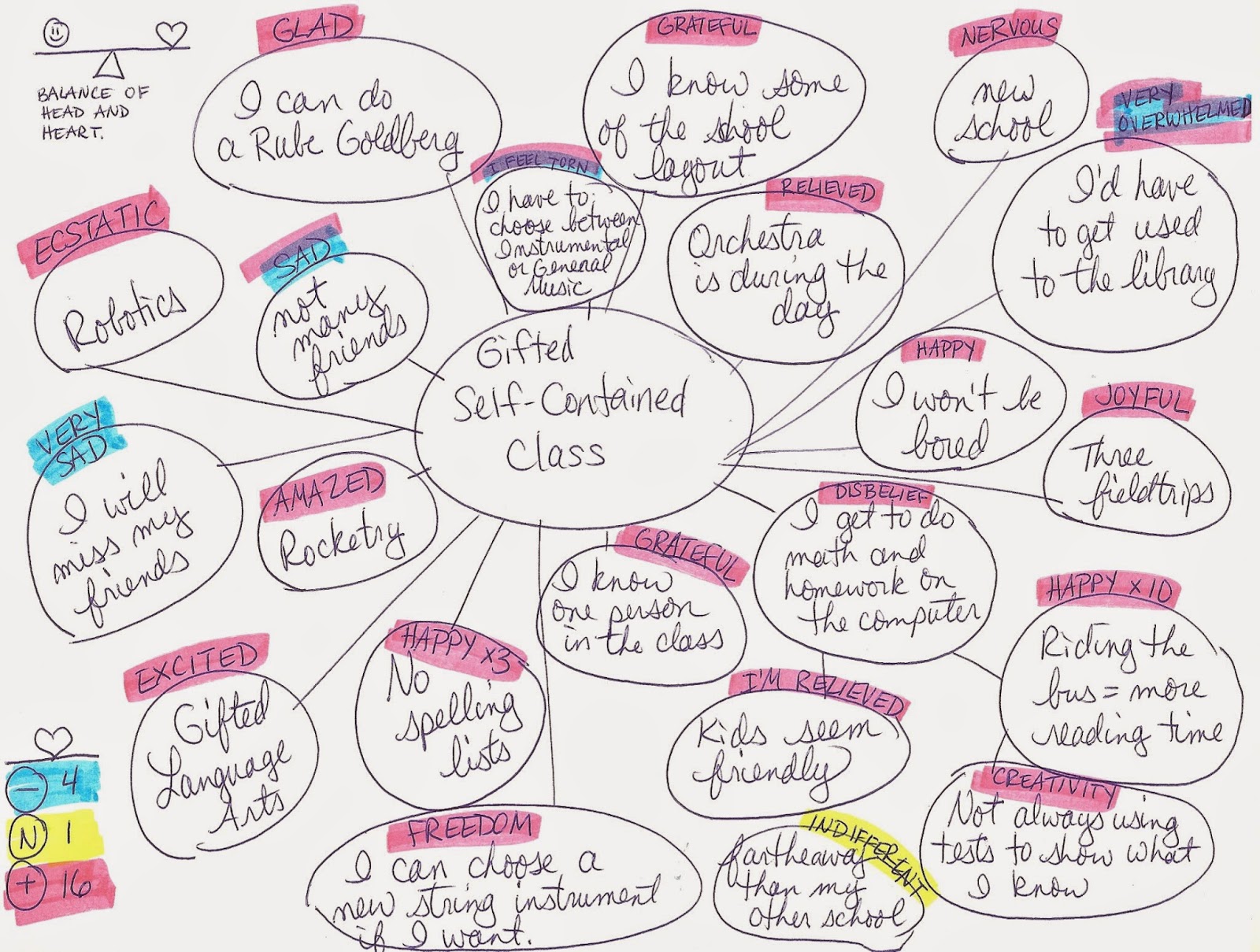
We also knew that emotions were very much a part of this decision making process and that's when the inspiration came.  We created a Bubble Map to explore the emotional factors of changing to the new school.  I first wrote every PRO and CON from the PRO/CON list for the new school in bubbles on the page.  


Then I asked my son to use a Feelings Chart to help him identify the feeling he felt as I read each statement in the bubbles.


I wrote his feeling label next to the appropriate bubble.  At this point he needed a break.  It can be emotionally exhausting to discover and honestly express feelings. 

An hour or so later, I called him back to the kitchen table.  He was ready to continue our discussion.  I read the emotional labels he had given and I asked him to tell me if it was a positive, neutral or a negative feeling.  I hi-lighted the feelings according to the colors in the key I had made at the bottom of the bubble map.  We then tallied each emotion grouping.  Even though there were four times more positive emotions than negative emotions, the negative emotions felt very heavy to my son.  I then asked him, regarding each negative feeling, if it was permanant or if it could change.  For three out of the four negative emotions, he realized strategies in which the situation could change and therefore the emotion could become positive.  We re-labeled with the "positive" color. 

The last one he did not know how to deal with - "I will miss my friends."  I ached for him.  I had gone through a few moves and changes in my life.  I felt he would feel more empowered if he came to his own conclusions ... so I told him a story.  I told him how I had been able to keep in touch with my friends after one of my moves.  He jumped up, finally with a smile on his face.  "I could write each of my friends a letter and give them your email and our phone number!"  He had a smile on his face.  He felt hope.  He ran to the computer to start typing his letters.

My son printed his letters and gave them to his friends the next day.
  
This was our final bubble sheet.  There are more details to this story which I wrote up in an earlier blog article in March 2014. 

Parent Supports for Transitions - Looking Back, Looking Forward

Looking Back.  If you have been involved on the campus you are leaving, you have felt a part of a community.  You may be concerned about the hole you will leave.  If so, consider making a list of helps and tips you can leave behind in order to help provide continued support. This may include -
  • Create a timeline and list of procedures to pass along. Include your contact information in case there are any questions.
  • Offer to be a “shadow leader,” meeting occasionally with new leaders from the campus to be a consultant

Looking Forward.  Realize that you have the opportunity to enlarge your sense of community on the new campus.  As you stay in touch with friends, you can also increase your sense of community as you -


Conclusion

The purpose of this presentation and this post is to help parents feel empowered in the decisions they are facing.  Every child is different.  Every gifted child is different.  As parents we can gather information and lead by example.  We can guide our children in making weightier decisions with both our heads and our hearts.  As we do this, we will be more likely to find a program that fits our child's genuine needs.

*If you would like to become familiar with the funding history of gifted education in Arizona, you are invited to read the February 1, 2015, blog post - Gifted Education Funding in Arizona.

Monday, October 6, 2014

Seeing the Forest for the Trees - By Stephanie Newitt

Dr. Amy Serin of the Serin Center was the keynote speaker at the September, AAGT Parent Institute.  She had these thoughts to share regarding parenting gifted kids to help us as parents see the forest for the trees.

Dr. Serin began with some biology and a look at brain cortical thickness.  This is the area of the brain that among a variety of cognitive abilities plays a key role in attention and perceptual awareness.   She shared with us a study that was conducted comparing the cortical thickness of children with typical intelligence to that of children with IQs in the 120s-130s.  The study found that in the group of gifted children, the cortex thickened at about age 11 years, but that the cortex thickened years earlier for children of typical intelligence.  

What does this mean to parents of gifted children?  This means, that biologically speaking, gifted children will struggle with their ability to self-regulate until about the age of 11 years old.  Combine this with their heightened curiosity and there is no wonder that young gifted children get distracted on their way to complete simple tasks such as feeding the dog or turning in homework. 

What can we as parents do to help our children who are still developing self-regulating abilities?
·         We can look at them and their development through the lens of giftedness. 

·         Don’t “should” your gifted child.  We tend to do this because we want THEM to make our lives easier.  Don’t look at typical kids to be the standard of a gifted child’s development.
·         Modulate expectations based on your gifted child’s needs.  Which executive functioning (self-regulating) trait does your gifted child have difficulty with?  Shifting activities?  Regulating their intense emotions?  Their overexcitibility? 
·         Motivate your gifted child, not with logic, but with rewards that will activate the dopamine levels in the brain.  Be aware of your gifted child’s developmental stages and identify their asynchronies.
·         As parents, we may need to BE the frontal lobe – giving direction and structure – while the brain of our gifted child is developing.  An example of this is that it is time for your gifted child to clean up her room.  You can break it down for them and give the direction to gather dirty clothes first, then help them with a short list of items they will gather together and put away (dolls, cars, etc.) 


·         Don’t parent based on parental entitlement.  Parent based on your child’s genuine needs.
·         Model self-soothing behavior and discuss with your gifted child why you chose this behavior and how it helped you.  Train your child to use appropriate self-soothing behavior also.  This can be as simple as when a project is frustrating, you get up and take a short walk in the fresh air.
·         When parenting your gifted child, empathize, discuss (but don’t focus on logic), distract, and put the situation into perspective.  Use humor. 

To illustrate this point, I remember when my 11 year old son was very frustrated that I had asked him to pick up the fallen citrus in the backyard.  “But I just did it last week!  I shouldn’t have to do it again!” he balked.  I let him know I understood, and that I was just thinking about him.  Since his older brother was about to mow the lawn, I thought he would prefer to pick up whole citrus as opposed to cut up pieces of fruit.  He repeated his mantra of frustration.  I then looked at him, and in a voice of empathetic frustration, said, “Well, then, you should take it up with the trees and tell them they have no business dropping fruit when you just picked up their mess last week!”  My son smiled, rolled his eyes, shook his head … and got his garbage bags and gloves.  
·         Dr. Serin continued … Regarding bullying.  Are you as a parent succumbing to victim mentality?  Be sure to not project a victim mentality on to your child.
·         Regarding self-regulating / executive functioning skills, Dr. Serin recommended the book -   Smart but Scattered: The Revolutionary "Executive Skills" Approach to Helping Kids Reach Their Potential by Peg Dawson and Richard Guare.

I highly recommend the annual AAGT Parent Institute to any parent of a gifted child.  Each time I go I’m reminded I’m not alone in this journey of parenting gifted children and I also bring home little nuggets of knowledge and skill that elevate my perspective.  I arrive home with greater peace – I remember that I love the panoramic view of the forest.

If you weren’t able to attend the AAGT Parent Institute this year, then please be sure to come to the Gilbert Supporters of the Gifted quarterly guest lectures.  Come to the GSG guest lectures and you will feel like you are not alone in this journey,  you will take home your own nugget of knowledge to raise your parenting perspective, and you just might find your own peaceful view of the forest.

MARK YOUR CALENDAR!  The next GSG Guest Lecture is Thursday, November 13th. 

If you liked this article, then you will really enjoy our November topic:  Ideas to help Gifted Children with Executive Functioning Skills.

SEE YOU ON NOVEMBER 13TH!

Monday, June 30, 2014

Locating Age-Appropriate Books for High Ability Learners

I came across this great chat article about finding age-appropriate books for high ability learners.  

In this article they start off stating the following:
"Locating age-appropriate books for high ability learners can prove difficult  for several reasons. Asynchronous development may mean that a very young child could comprehend reading material well beyond what may be considered appropriate for their age... interest levels and sensitivities also play important roles when finding appropriate yet challenging books for these children. Jo Freitag ...commented that material deemed appropriate for a child’s chronological age might be considered too simplistic and unsatisfying to the child."

At the end of the article there are a few dozen worthwhile links to help parents who are struggling with this issue.

Wednesday, April 16, 2014

Asynchronous Development

By Stephanie Newitt, B.S. Early Childhood/Elementary Ed.

On April 10th, Gilbert Supporters of the Gifted hosted a guest lecture that focused on the asynchronous development of the gifted child.  How does child development play a part in gifted education?  That is what this lecture explored.

To begin with, let us review two components of the Gilbert Public Schools Gifted Mission Statement which was developed in 2012 by educators, administrators and parents in the Gilbert community.  The GPS Gifted Mission Statement, in part, states that GPS seeks to …
·         Address the specific needs of gifted, highly gifted, profoundly gifted and twice-exceptional students …
·         Address the social, emotional, cognitive, academic, physical, and kinesthetic needs of each gifted or twice-exceptional student.

First, what does it mean to be gifted, highly gifted, profoundly gifted, or twice exceptional?  
Doesn’t gifted just mean really smart?  To better understand this, we need to step back and obtain perspective.  Let’s look at the common bell curve, the height of the bell curve representing students with typical intelligence. 


Those on the extreme far left fall far below the norm and qualify for special education services.  

We can see that those on the extreme far right are the same distance from the norm and qualify for gifted education services. 

Within Special Education there is a spectrum:  mild, moderate, and severe/profound.  Those unique individuals who qualify for special education services due to the unique “hard-wiring” of their brain have very specific intellectual and developmental needs.  They therefore, require services to grow and meet their potential.  Not all students in special education receive the exact same types of services.  Services are based on student needs. 

Now let’s look at the gifted spectrum.  That’s right, giftedness also has a spectrum:  gifted, highly gifted, and profoundly gifted.  These unique individuals also have a unique “hard-wiring” of their brain which affects their intellectual and developmental needs.  They too genuinely need appropriate services in order to grow and meet their potential.  Not all students in the gifted spectrum should receive the exact same types of services, as services should again be based on student needs.

A student who is Twice Exceptional (2e) qualifies for BOTH the special education and gifted education services.  This could be a child who has dyslexia but functions above grade level in math.  This could be a student who reads three levels above grade level but who also operates within the autism spectrum.

We have defined the gifted spectrum.  Now, let’s move on to the second point we wish to cover - addressing the needs of the whole gifted child.  Why is this necessary, I mean, aren’t all gifted students well adjusted in school?  To answer this question, let’s look again at our typical student.  A typical 12 year-old student at the height of the bell curve most likely functions at grade level in almost all areas and has hit almost all developmental milestones within appropriate times, give or take some individuality.   Their overall development is in synch with the age of their body, or their chronological age. 

A gifted child, due to their unique hard-wiring, experiences development that is “out of synch,” or asynchronous, to their chronological age.  Their hard-wiring affects the depth and breadth of their emotions, which can be hard to self-regulate; their intellectual processing speed, and their ability to notice and internalize social cues.  Let’s look at both of these students on a bar graph.  They have the same chronological age, but their developmental areas fall in very different places.


Asynchronous development is the defining characteristic of gifted children. 

Dr. Linda Kreger Silerman has stated, "...gifted children develop in an uneven manner, ... they are more complex and intense than their agemates, ... they feel out-of-sync with age peers and 'age appropriate curriculum,' ... the internal and external discrepancies increase with IQ, and ... these differences make them extremely vulnerable.”

As giftedness increases on the spectrum, the child’s development becomes more and more “out-of-sync” with age peers.

Let’s try another visual.  Let’s imagine circles within circles.  Like tree rings, each circle indicates an age.  For a typical student, like a tree, the most outer ring is the student’s chronological age and the age of their overall developmental levels, again, give or take some individuality.  The circle is divided up into pie shaped slices, each slice indicating an area of development.  For the typical student, the circle is filled in nicely. 


Let us look at how such a pie chart may appear for a gifted student.


The gifted student’s pie chart is very different from that of a typical student and their unique needs and deficits require services in order for growth to occur.  Because of their asynchronous development, gifted students can experiences difficulties in school – academic as well as social.  

Gifted education is recognizing where a student is in their areas of development, across all slices of the pie, and providing support for their strengths as well as their weaknesses.  Gifted Education is also understanding the emotional intensities and perfectionistic tendencies that impact the learning and growth of gifted students. 

As parents and educators we need to recognize, understand and provide support for our gifted students in their asynchronous development.  As much as we would like to always be able to treat our 12 year old child like the 17 year old mathematician that she is, we need to remember that ability does not equal maturity.  Providing her with complex math is fair and appropriate; it is also fair and appropriate to treat our mathematician like a 12 year old when we give out responsibilities, express expectations and introduce her to new social situations.

As Gilbert Public Schools looks forward to fulfilling its Gifted Education Vision:

Gilbert Public Schools is a premier provider of services to Pre-K through Grade 12 students identified as gifted or twice-exceptional, using research-based instruction to address the needs of the whole child.

GPS understands that more teacher-training needs to be provided.  To this end, GPS is increasing its professional development offerings in gifted education for its educators.  Gilbert Supporters of the Gifted will also continue to provide opportunities for parents to better understand the giftedness of their children.  Together, as parents and educators, we can provide appropriate support for the gifted students and their families within our community.

In conclusion, we need to remember –
•       ASYNCHRONOUS development is TYPICAL  development for a gifted child.
•       A gifted child’s intellectual age is often well-above their chronological age, but their judgment is often more closely aligned to their chronological age.
•       Intelligence and knowledge ≠ emotional maturity, understanding or wisdom.
•       Adults who are unaware of a child’s asynchrony can easily fall into the trap of expecting the child to act her older mental age rather than their younger chronological age.
•       The more gifted a child, the more likely he is to have a wide spread of abilities.
•       To be aware of our gifted child’s asynchrony. 
•       More information on asynchronous development can be found in the book A Parent’s Guide to Gifted Children by James Webb, et. al.